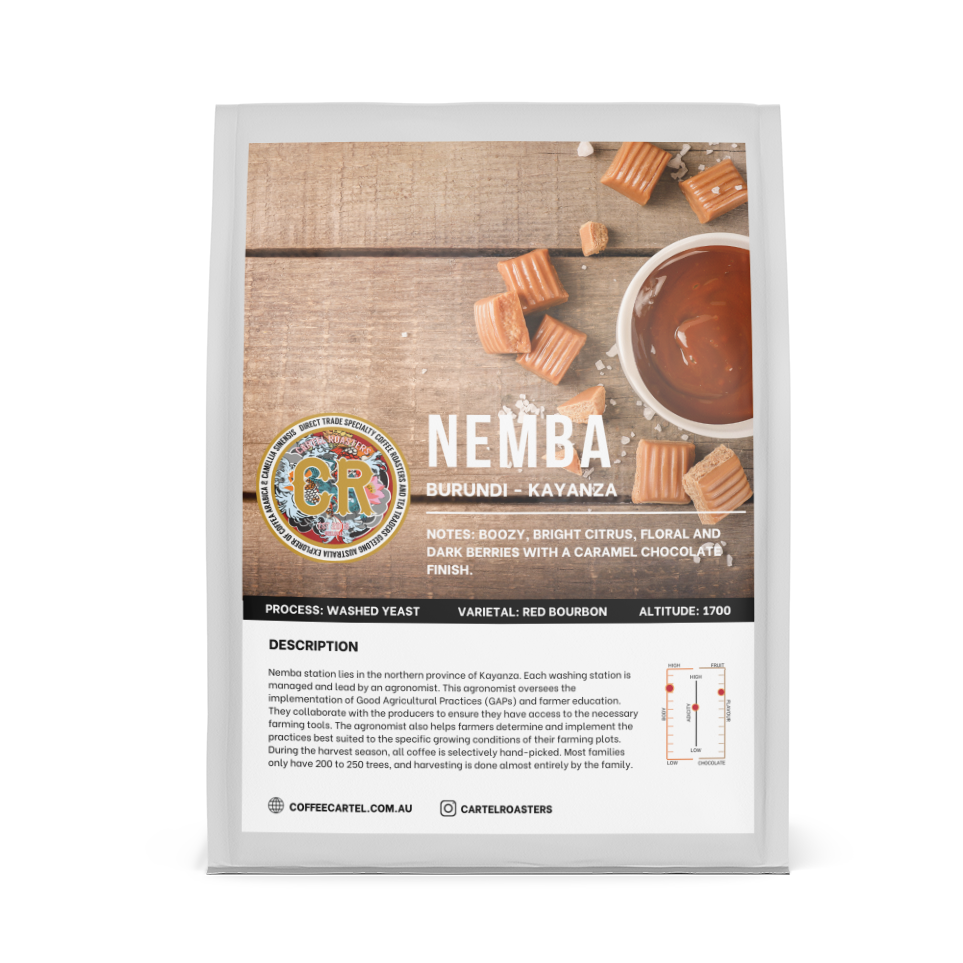
Many trees in Burundi are Red Bourbon. Because of the increasingly small size of coffee plantings, aging rootstock is a very big issue in Burundi. Many farmers have trees that are over 50 years old, but with small plots to farm, it is difficult to justify taking trees entirely out of production for the 3 to 4 years it will take new plantings to begin to yield. In order to encourage farmers to renovate their plantings, Greenco purchases seeds from the Institut des Sciences Agronomiques du Burundi (ISABU), establishes nurseries and sells the seedlings to farmers at or below cost. At the washing station, farmers can also get organic fertilizer derived from composted coffee pulp.
Despite the ubiquity of coffee growing in Burundi, each smallholder produces a relatively small harvest. The average smallholder has approximately 250 trees, normally in their backyards. Each tree yields an average of 1.5 kilos of cherry so the average producer sells about 200 to 300 kilos of cherry annually.
During the harvest season, all coffee is selectively hand-picked. Most families only have 200 to 250 trees, and harvesting is done almost entirely by the family.
After sorting, cherry is pulped within 6 hours of delivery. During pulping, cherry is separated into high- and low-grade by density on a Mackinon 3-disc pulper outfitted with an additional separation disk. Once pulped, coffee is placed in Epoxy-coated, concrete fermentation tanks. Cima yeast purchased from the French company Lalcafe is added to the tanks. The tanks are then covered and left to ferment for approximately 12 hours.
LALCAFÉ CIMA™ yeast (Saccharomyces cerevisiae) was specially developed for coffee production over a four-year period of research and trials. Trials in various regions and environments showed that Cima is well suited to better control wet process efficiently and to upgrade the cup quality. The yeast is able to control the fermentation process and reduce the risk of spoilage micro-organisms that can generate undesirable defects. Furthermore, its specific metabolism and its high capacity, even at cold temperatures (minimum 15°C inside the coffee tank), allow for the expression of fresh and fruity characteristics, even at higher altitudes. The longer fermentation time for yeast processed coffees (washed processed typically ferments for about 12 hours) also allows for more developed flavors. The extra time enables the beans to absorb metabolites, which can enhance flavors. Complexity, acidity, brightness, floral and high notes and more are all boosted by the lengthened fermentation time.
After fermentation is completed, coffee is run through washing and grading channels. The channel separates beans into seven grades according to density. Then, parchment is poured onto wooden trays or nylon bags and carried to the drying tables, each in its separate quality group. Each tray and nylon bag of parchment keeps its traceability tag with all relevant info to maintain traceability throughout processing.
Coffee is transported to the drying tables where it will dry slowly for 2-3 weeks, during which time the parchment is repeatedly sorted and sifted to ensure even drying. The parchment is left to dry from sunrise to sunset and is covered with a sheet during the evening or when it rains. The moisture level is carefully monitored and any remaining damaged parchment is removed.